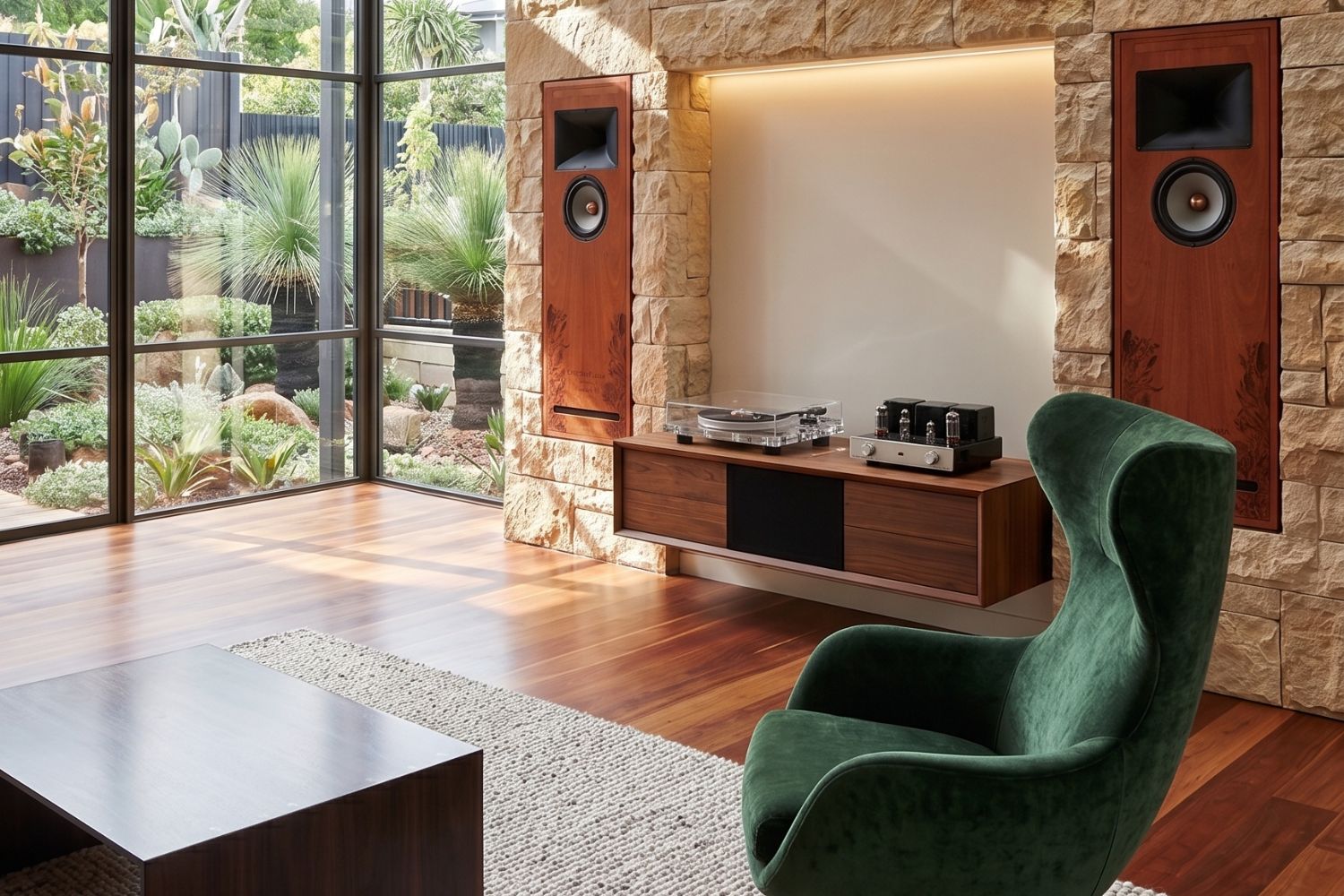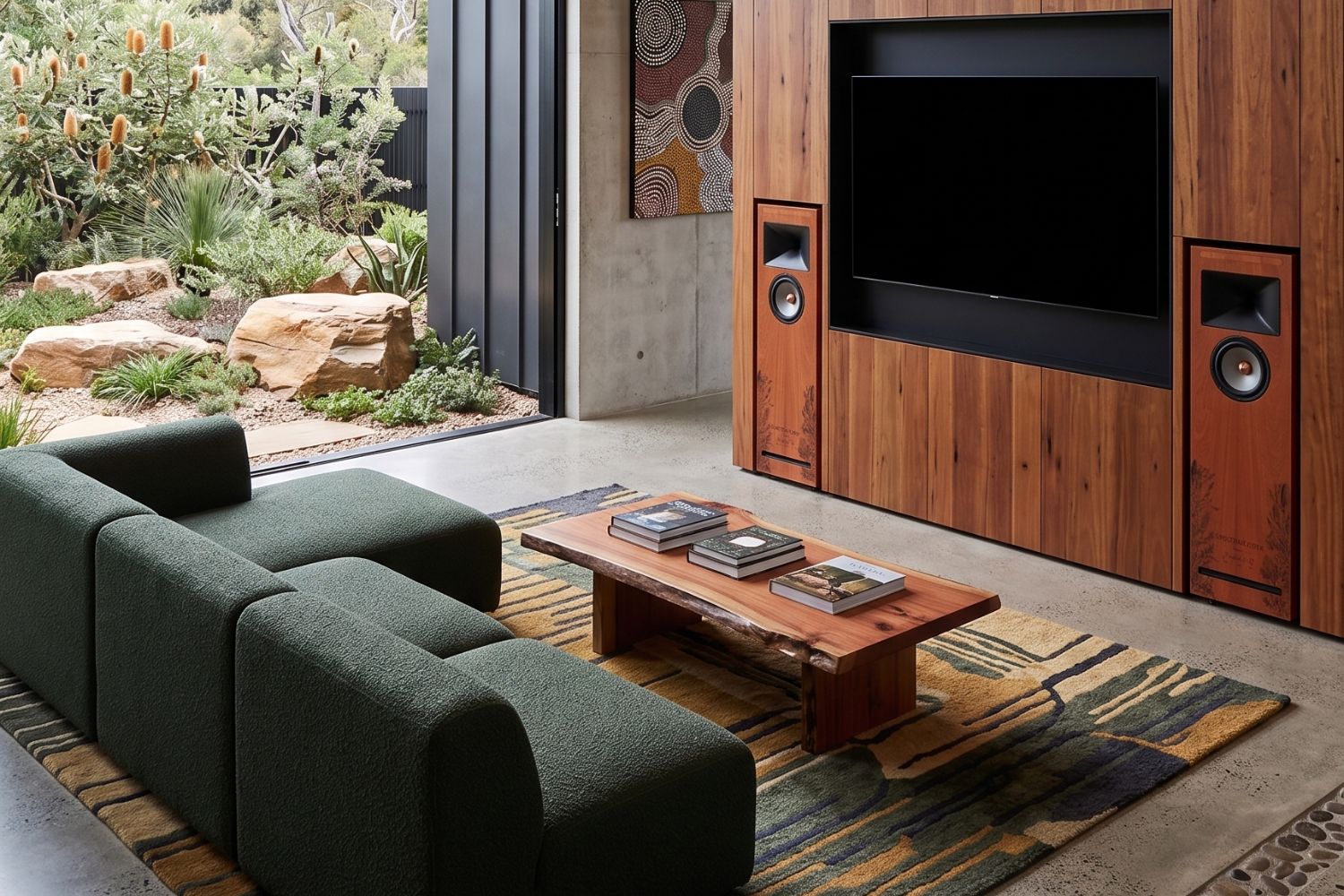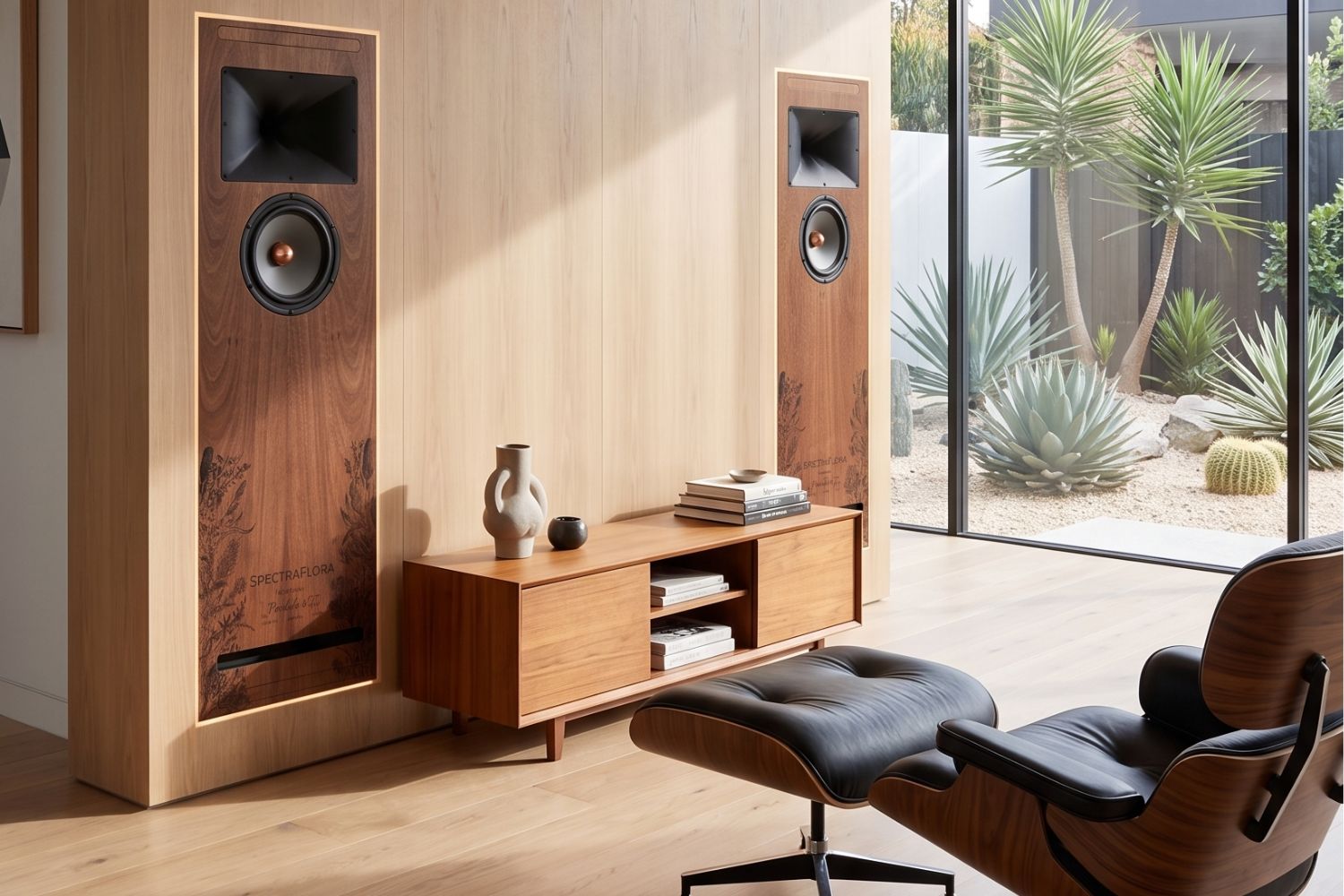
The SpectraFlora Pendula 8 TL brings high-end speaker engineering to a category that has long settled for less.
There is a moment in nearly every premium residential project where two priorities collide. The client has agreed to invest in considered architecture: cohesive material palettes, recessed lighting, clean ceiling planes, joinery that conceals what doesn’t need to be seen. Then the audio-visual scope arrives, and the only in-wall speakers on offer are large, cheap-looking, slightly off-white grilles that interrupt every wall they touch — and, more often than not, sound like exactly what they are: a driver in a cavity.
This is a problem worth solving. Sound is the one element of a home that occupies it completely. Light defines a room; sound inhabits it. And while architects have long had the freedom to choose lighting that complements the design, in-wall speakers have remained a compromise — a category where appearance has been treated as the only design variable, and acoustic performance has been treated as someone else’s concern.
The SpectraFlora Pendula 8 TL is built on the premise that this compromise is unnecessary.
A boutique approach, behind the wall
SpectraFlora is an Australian loudspeaker manufacturer based in Victoria. Its first product, the Celata 88 freestanding loudspeaker, has been named Product of the Year by both SoundStage! Australia (2025) and Sound+Image (2026) — the kind of back-to-back recognition normally reserved for large global brands. The Pendula 8 TL is the company’s first architectural product, and it carries the same design discipline into a category that has historically been treated as an afterthought. It is designed first and foremost for in-wall installation; a freestanding variant is offered for projects where in-wall integration isn’t practical.

The “TL” in the name refers to transmission line loading — a cabinet design principle far more often associated with premium freestanding speakers than in-wall installations. In a transmission line, the rear output of the driver is routed through a long, tapered, internally damped acoustic path before exiting the enclosure. Done properly, this approach produces bass that is deeper, tighter, and more detailed than what a small sealed or ported in-wall enclosure can manage. Done poorly, it doesn’t work at all. It is not a design choice taken lightly, and rarely attempted in a product that has to fit within a wall cavity.
That constraint is the engineering story. Most in-wall speakers don’t have a proper enclosure at all — the wall cavity behind them is treated as a free, uncontrolled resonant box. The result is the sound most people associate with in-wall installations: thin, congested, vague. The Pendula 8 TL is, by contrast, a complete, self-contained acoustic system. The wall around it is asked to do only what a wall is supposed to do.
What this means for the project
For architects and designers specifying the Pendula 8 TL, a few practical things change:
- The speaker is engineered as a self-contained acoustic system, so its performance does not depend on the construction of the wall around it. Behaviour is consistent between a brick-veneer wall and a lightweight partition.
- The grille is a custom fabric panel rather than a paint-it-and-hope-for-the-best plastic frame. The fabric is specified per project, which means the speaker face can be matched to upholstery, drawn from the same palette as a wallcovering, or set deliberately in contrast. The speaker becomes a textile element of the room rather than an apologetic interruption to it.
- Low-frequency performance is taken seriously rather than written off as a limitation of the form factor — that is the entire reason for the transmission line approach.
- Because each unit is its own enclosure, room-to-room sound isolation is improved. Adjacent rooms do not share an acoustic cavity through the speaker.
These are not subtle differences when the installation is for a primary living area, a media room, or any space where the client will actually listen.
An Australian product, designed for Australian builds
The Pendula 8 TL is designed in Australia and manufactured to SpectraFlora’s specification, with the same attention to driver selection, crossover design and enclosure engineering that defines the company’s freestanding range. It is not a generic offshore in-wall rebadged for the local market. It is a considered architectural product from a manufacturer whose freestanding speakers have already been recognised at the highest level of the Australian HiFi press.

For practices working on premium residential or boutique hospitality projects, this matters in two ways. First, the speaker can be specified with confidence — the engineering pedigree is verifiable, not asserted. Second, the supply relationship is direct, local, and responsive. Specification queries, sample organisation and project-level support come from the designer himself, not a distribution layer.
The brief, simplified
When the goal is a home that looks resolved and sounds alive, the path is straightforward:
- Specify the Pendula 8 TL where music or film actually matters — primary living areas, dedicated listening rooms, media rooms, primary bedrooms.
- Specify the grille fabric to suit the room — matched to the textile palette, drawn from the wallcovering, or chosen as a deliberate accent.
- Brief the AV contractor that the Pendula 8 TL is a sealed transmission line system; no additional back-box construction is required.
The result is that rare thing in residential audio: a speaker the architect doesn’t have to apologise for, and that the client hears properly — perhaps for the first time.
The SpectraFlora Pendula 8 TL is available direct from www.spectraflora.com. For technical documentation, dealer enquiries and project consultation, contact listen@spectraflora.com.