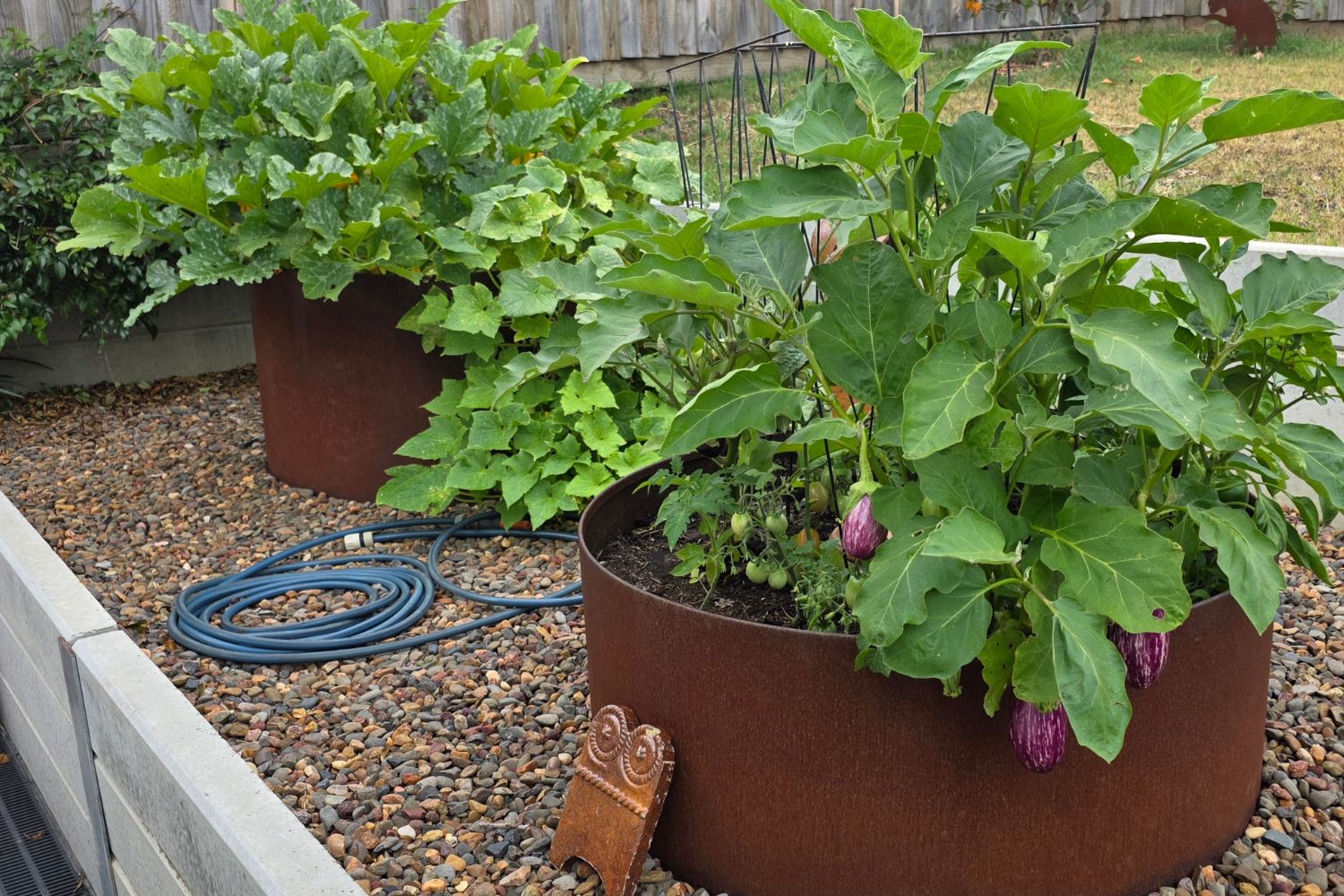
Poor soil? No space for a garden? Raised weathered steel planters are the perfect solution.
How do you start a small vegetable garden when your soil isn’t up to scratch? That’s the conundrum that faced these owners when they moved into a newly built house.
The slightly sloping block was covered in builder’s fill that in turn sat on a layer of sand with near-impenetrable clay just under the surface. The only things that grew in it with any conviction were weeds and feral grass.
Once the hard landscaping was done and two retaining walls had gone in, it was time to address the problem of the vegie garden. The answer turned out to be both practical and decorative.
They bought three ShapeScaper Redcor steel rings in different sizes from the local landscape supplier and had them delivered with a load of river pebbles and a pile of specialised vegetable mix soil.
Also called weathering steel, Redcor is a steel alloy containing chromium, copper, nickel and phosphorus similar to Corten. When exposed to the elements, it quickly acquires a patina of rust that remains stable and actually prevents deeper corrosion.
On a 2m-deep shelf formed by the retaining walls, three rings of different heights sit side by side on top of the pebbles. They are filled first with a layer of stones and bricks topped by a good depth of the vegie garden mix.
Each one has an improvised olla in the centre to keep the surrounding soil moist. These are permeable terracotta pots (rather than watertight glazed ones), their drain holes plugged
with silicone chair-leg caps and their saucers repurposed as lids. The soil in the rings was then topped off with mulch.
Through spring into summer, the rings produced tomatoes, two kinds of cucumber and two varieties of eggplant, plus zucchini, capsicums, carrots and beetroot. Except for the carrots (they were wonky but tasted great), the veg were all healthy and well formed.
Pollinators found the plants in no time — blue-banded and honeybees, mostly. The home owners contributed regular Seasol and Swift Grow fertiliser to keep things humming along.
This winter they will house peas, brassicas and more root veg. At the other end of the pebbled area, separated by a curved strip of Redcor steel, is a native garden formed by sheet mulching over the builder’s fill.
It is now so full of earthworms it’s getting holes pecked everywhere by magpies and kookaburras.
If your only available space is a paved courtyard or balcony, as is the case for most unit and apartment dwellers, these raised steel planters are the way to go.
Importantly, they don’t deteriorate the way wooden planters do, or crack and fade in the sun like plastic containers. Weathered steel’s rust patina goes on looking good year after year.
Because steel planters are all about the depth of the soil rather than the breadth, you might have to consider balcony load limits. Other factors to take into account are drainage and sun exposure.
A contained system has its advantages: soil can be easily improved and replenished, crops can be rotated easily and maintenance is manageable rather than overwhelming.
And there’s quite a range of plants suited to confined environments,
from fast-growing leafy greens and pick-and-come-again herbs to compact vegetable varieties bred specifically for small gardens.
Finally, if you’re renting and you have to move, with a little deconstruction you can even take your rings with you.
To find out more, visit the ShapeScaper website.


